
SEO vs. GEO vs. AEO: What Does Your Business Actually Need in 2026
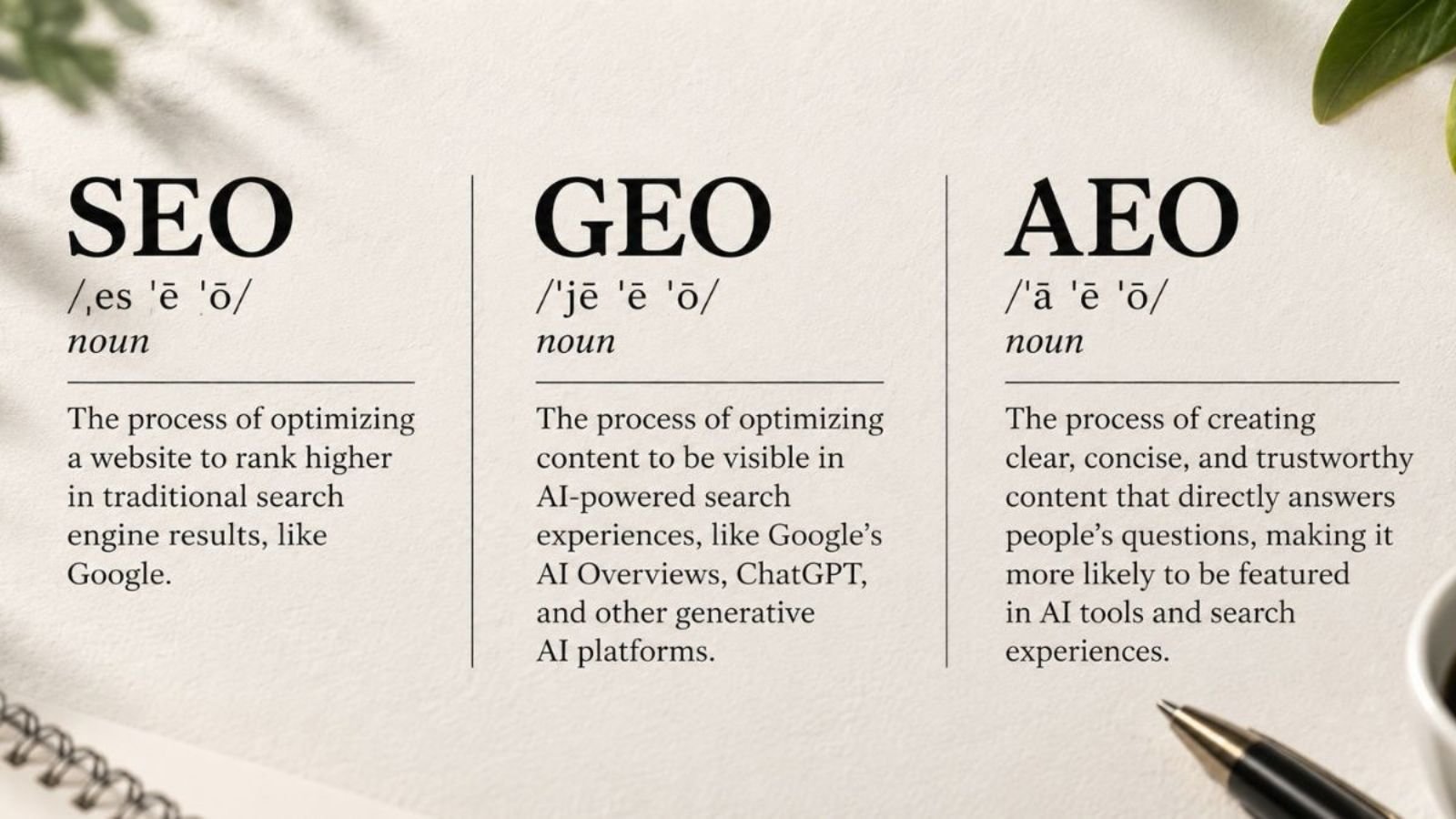
A recurring question among business owners is whether they now need to focus on SEO (Search Engine Optimization), GEO (Generative Engine Optimization), AEO (Answer Engine Optimization) , or all three. The question often comes after a website has already been updated, yet customers still ask questions the business expected its online information to answer.
The issue is often not a lack of content. It is whether the information is clear, complete, consistent, and organized around the questions customers actually have.
The Difference Between SEO, GEO, and AEO
SEO, GEO, and AEO overlap, but each emphasizes a different part of the information journey.
In simple terms, Search Engine Optimization (SEO) helps people discover relevant information, Answer Engine Optimization (AEO) answers specific questions directly, and Generative Engine Optimization (GEO) makes information clear, contextual, and useful when generative systems assemble responses.
A common misconception is that businesses need three completely separate content programs. In practice, one well-developed page can support several of these needs when it clearly explains the subject and provides enough context.
| Approach | Primary focus | Useful content |
|---|---|---|
| SEO – Search Engine Optimization | Helping customers discover relevant information | Service pages, topic pages, organized website content |
| GEO – Generative Engine Optimization | Making business information clear, contextual, and easy to interpret | Detailed explanations, consistent information, clear relationships between topics |
| AEO – Answer Engine Optimization | Providing direct answers to specific questions | FAQs, definitions, comparisons, process explanations |
The practical difference comes down to customer intent. Someone trying to find a service has a different information need from someone asking whether that service is appropriate for a particular situation.
Customer Questions Reveal the Information Gaps
Before deciding which approach deserves attention, businesses can look at the questions already coming up in phone calls, consultations, sales conversations, and service inquiries.
Recurring questions often reveal information that is technically available online but not explained clearly enough. Customers may want to know what a service involves, when it is necessary, what affects the decision, or what happens after they contact the company.
A useful review can group these questions into several categories:
- Service questions: What does the company provide?
- Decision questions: Which option fits the situation?
- Process questions: What happens after contacting the business?
- Comparison questions: How do two services or solutions differ?
- Practical questions: What should the customer prepare or consider?
For GEO, these questions are particularly useful because they reveal the context that may be missing from existing information.
For example, a service page may state that a company provides window replacement. A customer may still need to understand when replacement is appropriate, how frame condition affects the project, and what circumstances could change the recommended approach.
Not every question needs a separate article. The key is making sure the answer lives in a clear, appropriate place.
Strong Information Foundations Still Matter
Newer approaches do not eliminate the need for accurate, well-organized business information.
A website should clearly communicate its services, business details, processes, and relevant terminology. Information should also stay consistent, rather than describing the same service in conflicting ways across pages.
This matters for GEO because context can be lost when information is scattered or ambiguous. A business may publish several pages about a service, but if those pages use inconsistent terminology or leave important qualifications unexplained, the overall information becomes harder to interpret.
A practical review should follow the customer’s path through the website:
| Customer need | Information to review |
|---|---|
| Understand the business | Main service and company information |
| Find a specific service | Service pages and navigation |
| Decide between options | Comparisons and decision guidance |
| Understand a process | Step-by-step explanations |
| Resolve a specific question | FAQs and supporting resources |
| Take the next step | Contact information and relevant calls to action |
This is also where businesses can avoid a common mistake: creating more content when the real problem is unclear or incomplete information on pages that already exist.
Clear Answers Need Context
AEO is sometimes reduced to the idea that every question should receive a short answer. That approach can remove the context that makes an answer useful.
A stronger answer starts directly with the customer’s question, then explains the circumstances that could change the answer.
For example, instead of simply stating that a particular service is necessary, a useful explanation can identify the conditions that make it relevant, the factors that may affect the decision, and what the customer should consider next.
A practical answer structure is:
- Answer the question directly.
- Explain when the answer applies.
- Identify relevant exceptions or decision factors.
- Give the reader a useful next step.
This structure also supports GEO because information can be understood without relying on surrounding paragraphs to fill in missing context.
Industry experience adds another layer. Professionals often know which distinctions customers misunderstand, which terms require clarification, and which details can change the appropriate course of action.
The goal is not simply to make an answer shorter. It is to make the information unambiguous and useful.
Making GEO the Practical Priority
Once information gaps are identified, the next question is where GEO should influence the content strategy.
GEO does not necessarily require a separate type of page. In many cases, it means improving the information already being published so that the business, its services, and the relationships between related topics are easier to understand.
A business can look for several practical signals:
| Information Issue | Recommended Action |
|---|---|
| Customers do not understand a service | Clarify the main service information |
| Important information is spread across pages | Connect or combine the relevant details |
| Customers ask the same question repeatedly | Provide a clear answer with supporting context |
| Customers often compare two options | Explain the factors that affect the decision |
| A topic has important qualifications | Clearly state the conditions that apply |
| Business information differs between pages | Review terminology and details for consistency |
SEO and AEO can support these improvements rather than functioning as entirely separate projects. A service page can help customers discover a business, answer common questions, and provide the context needed to understand the service.
The emphasis should follow the information problem. The objective is not to produce more pages simply because another acronym has become important.
Frequently Asked Questions
Does GEO require a separate page?
No. GEO can be supported by improving existing service pages, FAQs, articles, and other business information. The priority is making important information clear, complete, contextual, and consistent.
Should every customer question become an FAQ?
No. Some questions are better answered within a service page, comparison, process explanation, or longer resource. The appropriate format depends on how much context the customer needs.
Does concise content always work better for GEO?
Not necessarily. A direct answer is useful, but complex subjects often require qualifications, examples, and supporting details to prevent the answer from becoming misleading or incomplete.
How does factual consistency support GEO?
Consistent business names, services, terminology, locations, processes, and other important details make information easier to interpret. Conflicting information can create ambiguity, particularly when related details appear across multiple pages.
Can existing content be improved for GEO?
Yes. Existing pages can often be strengthened by answering recurring questions, clarifying terminology, adding missing context, updating outdated information, and making important facts easier to understand.
Naples SEO Company | Providing the BEST SEO Company in Naples, FL
We are a premier internet digital marketing company providing:
- Naples Search Engine Optimization SEO services
- Online presence
- Website Design
- Local SEO Strategy
- Email Marketing
- Social Media Marketing
- Marketing Campaigns
- Digital Marketing Strategy
- And More
Our marketing services goal is to continually over-deliver to each client we work with. We are a team of SEO experts, web design wizards, social media masterminds, and online reputation management specialists. With over 10 years of experience, we have developed a system that ensures the success of our clients with our products and services.
Our SEO agency is here to ensure your website is ranking high. Our goal is the top position. Exactly where the best, most qualified traffic is. Give us a call for your FREE Consultation.


